
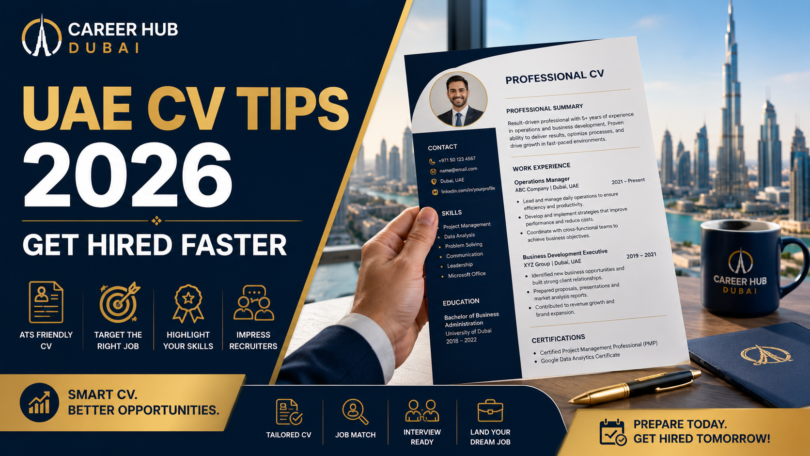

How to Write a CV for Dubai Jobs in 2026
In Dubai’s competitive job market, your CV has about 30 seconds to make an impression. That’s not a lot of time. Recruiters and HR managers go through hundreds of applications — and if your CV isn’t clear, well-structured, and relevant, it gets skipped.
The good news? Most CVs have the same avoidable mistakes. Fix them, and you move to the top of the pile. This guide covers exactly what a UAE-ready CV needs to look like in 2026.
Is a CV Different in the UAE vs Other Countries?
Yes — and understanding this difference matters. In the UAE and across the Gulf, it is standard and expected to include personal details that some Western countries consider optional or even inappropriate, such as:
- Your photo (professional headshot)
- Date of birth / age
- Nationality
- Visa status (visit visa, employment visa, residence, etc.)
- Marital status
UAE employers routinely ask for these details because they affect visa sponsorship, accommodation eligibility, and visa transfer logistics. Include them clearly at the top of your CV.
The Ideal UAE CV Structure (2026)
1. Header Section
Start with your name (large and bold), followed by your job title or target role, and then your contact information: phone number, email, LinkedIn URL (if active), and city you’re based in (e.g., Dubai, Sharjah, or “Available to relocate”).
2. Personal Details Block
Include: Nationality | Date of Birth | Visa Status | Marital Status | Driving License (yes/no, and which type)
3. Professional Summary
Write 3–5 lines summarizing who you are professionally, your years of experience, key strengths, and what you’re looking for. This is not an objective statement. It should read like a confident, concise pitch. Avoid phrases like “seeking a challenging opportunity.” Be specific.
4. Work Experience
List your roles in reverse chronological order (most recent first). For each role, include:
- Job title and company name
- Location and dates (month/year)
- 3–5 bullet points of key achievements and responsibilities — use numbers where possible (e.g., “Increased sales by 22% in Q3”, “Managed a team of 8 staff”)
5. Education
List your highest qualification first. Include the degree, institution name, country, and year of graduation. If you have professional certifications (ACCA, PMP, IELTS, Six Sigma, etc.) relevant to your target role, list them here or in a separate Certifications section.
6. Skills Section
Keep this targeted. List technical skills (software, systems, languages, tools) and soft skills that are relevant to the role. Don’t pad this section with generic phrases — “team player” and “hard working” add no value.
7. Languages
In the UAE, language skills genuinely matter. List all languages you speak and your level (Native, Fluent, Conversational, Basic). Arabic proficiency is a significant advantage for many roles.
Common CV Mistakes That Hurt Your Chances in Dubai
- Sending a generic CV for every job. Tailor your CV for each application. Highlight the skills and experience most relevant to that specific role.
- Using a photo that’s unprofessional. Use a clear, front-facing headshot in professional attire. Not a selfie, not a travel photo.
- Making it too long. Two pages maximum for most roles. Senior executives can stretch to three pages. One page is fine for freshers.
- Spelling and grammar errors. Run it through a spell check and have someone else read it before you send. Errors signal carelessness.
- Not including visa status. Employers want to know if you’re already in the UAE and on what visa. This affects how fast they can onboard you.
- Listing responsibilities without results. “Managed customer service” is weak. “Managed a team of 5, achieving 94% customer satisfaction score” is strong.
Should You Use a CV Template?
Templates can be helpful for structure, but avoid overcomplicated graphic-heavy templates that look good on screen but confuse Applicant Tracking Systems (ATS) — the software that many large employers use to screen CVs before a human ever reads them.
A clean, simple format — black text, clear headings, readable font (Arial, Calibri, or Times New Roman in 11–12pt) — almost always performs better than creative designs with columns, icons, and colored headers.
One More Important Tip: Cover Letters
In the UAE, cover letters are not always required — but when a job posting asks for one, don’t skip it. A well-written, personalized cover letter of 3–4 paragraphs that explains why you’re a strong fit for that specific role can genuinely set you apart from candidates with similar experience.
Final Advice
Your CV is a living document — update it regularly, keep it targeted, and never send the same version to 50 employers and expect great results. The more relevant and specific your CV is to each role, the better your chances.
Career Hub Dubai offers CV guides, interview tips, and career resources designed for expats and job seekers navigating the UAE job market. Bookmark this page and keep coming back for fresh content.
Disclaimer: Career Hub Dubai is not a recruitment agency. The advice in this article is general guidance and may not apply to all industries or roles.

Leave a Comment