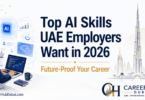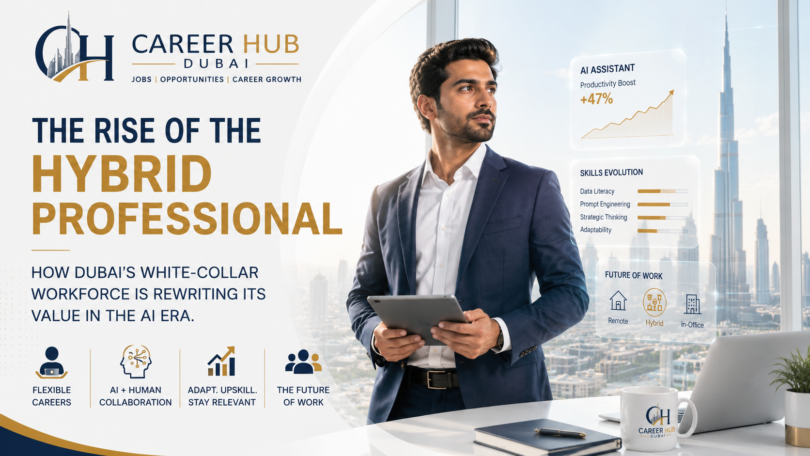

The Rise of the Hybrid Professional in Dubai’s AI Era
The conversation has shifted. Across boardrooms in DIFC, co-working spaces in Dubai Internet City, and HR departments throughout Abu Dhabi’s financial free zones, one question is replacing the old “AI will take your job” panic: How do I make myself impossible to replace? The answer, increasingly, is the hybrid professional — someone who fuses deep domain expertise in finance, marketing, HR, or law with working fluency in AI tools. For anyone pursuing jobs in Dubai 2026, this is not a trend to watch. It is the baseline expectation.
The UAE is not easing into this shift — it is leading it. The country recorded the highest AI adoption rate globally, with 64% of its working population actively using generative AI tools in their daily workflows, surpassing both the US and the UK. Dubai’s government has staked national economic strategy on AI, and private sector employers are catching up fast.
What Exactly Is a Hybrid Professional?
The term is straightforward. A hybrid professional is a subject-matter expert — an accountant, an HR manager, a legal counsel, a brand marketer — who has layered meaningful AI literacy and prompt engineering skills on top of their existing qualifications. They are not engineers. They do not need to build models. But they know how to direct them, interrogate their outputs, and integrate them into professional workflows.
Think of a mid-level finance analyst at a mainland Dubai holding company. Previously, her edge was Excel mastery and knowledge of IFRS standards. Today, she uses Claude or GPT-4 to draft variance analysis narratives in minutes, automates audit trail summaries, and flags anomalies in transaction data using AI-assisted scripts — skills she built through self-directed learning over four months. Her salary negotiation this year went up, not down.
The Three Domains Where Hybrid Skills Pay Most in the UAE
1. Finance and Banking
Financial hubs in DIFC and Abu Dhabi Global Market are actively recruiting professionals who combine CFA-level analytical rigour with tools like Microsoft Copilot for Excel, AI-driven financial modelling, and automated compliance reporting. The days of manually building 200-row PowerPoints for quarterly reviews are ending. The hybrid finance professional now prompts, edits, and presents — compressing three-day tasks into half a day.
2. Marketing and Content Strategy
Dubai’s retail and hospitality sectors — perennially competitive — have moved AI from “experiment” to standard operating procedure in their marketing stacks. A brand manager who understands audience segmentation, regional cultural nuance, and can generate and quality-control 30 pieces of multilingual content a week using AI is now one person doing the work of a small agency. This is a real competitive advantage for businesses managing campaigns across MENA markets.
3. Human Resources and Talent Acquisition
Emiratisation compliance targets imposed by MOHRE have made HR departments leaner and more strategically accountable than ever before. HR professionals who can use AI to map competency frameworks, draft Emiratisation-aligned job descriptions, automate screening workflows, and generate training impact reports are not just surviving the transition — they are getting promoted through it.
AI Skills in UAE: What Employers Are Actually Looking For
A persistent misconception is that “AI skills” means Python, machine learning, or data science. For most professional roles in Dubai, that is not the hiring standard. What employers are listing in JDs across Bayt.com, LinkedIn UAE, and GulfTalent in 2026 is far more accessible:
- Prompt engineering fundamentals — structuring queries to get reliable, usable outputs from LLMs
- AI tool fluency — Microsoft Copilot, ChatGPT Enterprise, Gemini Workspace, Perplexity, Midjourney for creative roles
- Output validation — critically assessing AI-generated content for accuracy, bias, and regulatory compliance
- Workflow integration — embedding AI tools into existing processes without creating shadow IT risks
- Data interpretation — reading AI-generated dashboards and translating insight into business decisions
Your 90-Day Hybrid Professional Roadmap
You do not need a career break to make this transition. Most professionals in Dubai add hybrid skills in parallel with their current roles. Here is a practical sequence:
-
Days 1–15Audit your current role List the five most time-consuming, repeatable tasks you perform weekly. These are your AI integration targets.
-
Days 16–30Pick one AI tool Copilot for Office users, Claude for analysis and writing, Midjourney for creative roles. Spend 30 minutes daily in active use — not passive watching of tutorials.
-
Days 31–60Complete one structured course The UAE’s Coursera partnership and Mohamed bin Zayed University of AI (MBZUAI) offer accessible AI literacy modules, some free to UAE residents.
-
Days 61–75Build a visible proof point A documented workflow, a case study, or a process improvement you can speak to in interviews and add to your LinkedIn profile.
-
Days 76–90Update your CV and LinkedIn “Senior Finance Manager | AI-Augmented Financial Analysis” signals the hybrid identity to recruiters scanning talent pools for jobs in Dubai 2026.
Freelancing in Dubai: The Hybrid Professional’s Second Income Stream
The UAE’s freelance infrastructure has matured substantially. The Dubai freelance visa — administered through platforms such as Dubai Media City, Dubai Internet City, and the TECOM freelance permit — allows professionals to operate independently with full legal standing. For hybrid professionals, this opens a significant second-income channel.
A marketing manager who builds AI-augmented content production skills can legitimately take on agency clients via a freelance permit while retaining their full-time position under a separate sponsorship arrangement — provided their employment contract does not restrict it. The Dubai freelance visa cost as of 2026 ranges from approximately AED 7,500 to AED 15,000 depending on the issuing free zone, inclusive of visa, permit, and medical.
| Free Zone | Permit Cost (AED) | Best Suited For | Visa Included? |
|---|---|---|---|
| Dubai Media City (DMC) | ~15,000 | Media, content, marketing | Yes |
| Dubai Internet City (DIC) | ~15,000 | Tech, consulting, digital | Yes |
| TECOM Freelance Permit | ~7,500–10,000 | Creative, management | Separate |
| Fujairah Creative City | ~6,000–8,000 | Broad creative & consulting | Separate |
What This Means for Jobs in Dubai 2026
The recruitment landscape in Dubai is bifurcating. Roles that once required four people are being managed by two who use AI effectively. This means fewer purely administrative positions, but a measurably higher ceiling for those who adapt. Recruiters on GulfTalent and LinkedIn UAE report that hybrid-skilled candidates command 20–35% salary premiums over peers with equivalent domain experience but no AI fluency.
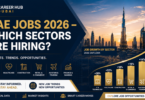
The opportunity is not evenly distributed across sectors. Real estate, construction, and government-adjacent roles are slower adopters. But financial services, professional services, media, retail, and hospitality are moving rapidly — and those are the sectors producing the most jobs in Dubai 2026 for expat and Emirati professionals alike.
People Also Ask
Ready to position yourself as a hybrid professional?
CareerHubDubai.com tracks the latest job openings, salary benchmarks, visa guides, and career strategies for Dubai’s evolving workforce — updated daily.
Explore Jobs & Career Guides →